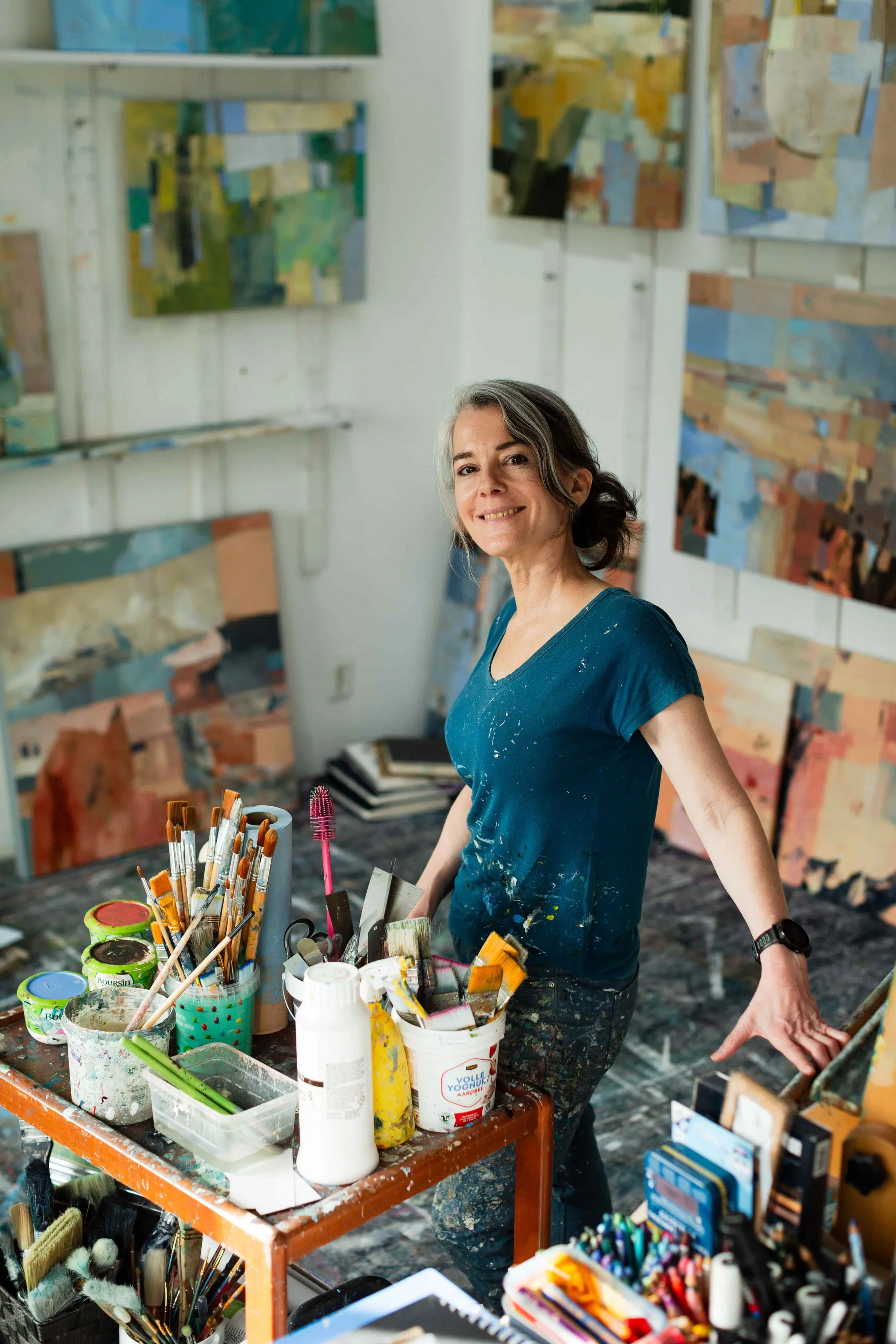
One of the “Nieuwe Stemmen” - Hayo Huizinga from Galerie De Ploegh interviews Cath Duncan
This article is a translated with permission. You can find the original Dutch version here.
Cath Duncan is one of the artists taking part in the exhibition Nieuwe Stemmen, on view at Galerie De Ploegh from 3 September through 11 October.
Cath welcomes me into her studio on the top floor of the house where she lives with her partner and son. Three global citizens, who previously lived in South Africa, Great Britain and Canada, and who have now found their place in the Netherlands.
What immediately catches the eye are the colours on the ‘drop cloth’: an array of colours and stripes, seemingly intertwined at random. Colourful, abstract works hang on the walls. Before long, we find ourselves talking, beginning with an anecdote from just before they left South Africa. In an almost empty house, the estate agent found only the architect’s drawing table still standing. It was still being used as a painting table. On it was the same colourful pattern that could be seen on the drop cloth. The estate agent was very taken with it.
For Cath, this became a starting point for re-examining her work. Her work had always been concerned with landscape, but from that moment onwards it became increasingly abstract.
Previously, painting for her meant being physically present in the landscape: sensing it with her heart, mind and body. Three years ago, she was commissioned in the Netherlands to make a painting of the landscape where an Australian couple lived. She did not know the area and could not simply travel there. Using images from Google Earth and photographs from newspaper articles, she nevertheless began working intuitively with colour, feeling her way through the process. She started on brown wrapping paper, exploring how the colours would interact and blend. The result was the large work Red Dust and Eucalyptus (2025).
She incorporates the wrapping paper on which she experiments with her colours into the final painting, on canvas or wooden panel. A few dominant colours and a range of mixed colours form the starting point. The selection is intuitive, based on what she finds beautiful. In this way, she discovered that diluted acrylic paint behaves differently on brown paper and can later evoke a particular atmosphere within the work.
There is no fixed plan. Precisely because of this, she continually surprises herself. An important concept in her work is serendipity: a fortunate discovery that arises from a chance combination of circumstances. You find something while you are busy doing something else. But such a discovery must first be recognised and then be put to use, alongside an understanding of composition and the placement of forms.
It begins with a sensory perception and a continuous interaction between listening to the painting as it develops and listening to her own inner landscape. In this way, the landscape on her canvases comes into being. Sometimes she recognises memories from her life within them; sometimes a poem emerges later that tells the same story.
Her work grows out of the transformation of uncertainty. This takes on an added significance because she literally lives with uncertainty: she is visually and hearing impaired and, following a kidney transplant, depends on medication that suppresses her immune system. No one knows exactly what life will bring under such circumstances.
The desire for control is therefore understandable, but at the same time Cath wants to feel free, remain in the here and now, and choose beauty and joy. Her way of painting is an antidote to uncertainty. She exchanges uncertainty for trust, openness and balance. Something fundamental is transformed into something new. This principle of transformation is the fuel that drives her work.
One could say that her way of painting grows out of her earlier work as a grief therapist. For many years, she listened to what people wanted to say and helped them find the words to express it. Now she does something similar with colour and texture. She looks, feels and listens to what the work is telling her, sometimes deliberately from the periphery of her vision, leaving room for surprise.
Her work is therefore also an invitation to the visitor. Through a QR code, she opens up a conversation with the viewer. On her website, you will find a welcome, an introduction, a poem and several questions about your own relationship with uncertainty. In this way, an interaction with the artist can still take place, even from a distance.
It is beautiful and sensitive work, and certainly well worth seeing at the gallery.